
How to Search the Gilmer County Court Docket
Start any Gilmer County docket search by picking the right court level. For Circuit Court records, use WVPASS. For magistrate results, use the Magistrate Case Search, known as MCR. These two public lookup routes are the official tools. Neither CourtPLUS nor the magistrate payment site takes their place. Glenville and Sand Fork municipal cases have no public docket portal of their own. Before you run the search, gather a party name. Also note the case number, the court, and a rough filing date. The exact number works best. A name alone can pull up several matches in the court docket. West Virginia's public instructions give no single case-number format for Gilmer County. So copy the number exactly as the clerk wrote it instead of guessing punctuation or a court code.
- Read the notice, citation, order, or prior filing to identify the court.
- Search WVPASS for circuit cases or MCR for magistrate cases.
- Match the case number, party roles, charge or case type, and filing date.
- Read docket entries for filings, settings, resets, orders, and disposition.
- Call or visit the correct clerk for a document, certified copy, or current date confirmation.
Two Gilmer County Court Docket Portals
WVPASS and MCR answer different questions. WVPASS opens public circuit case detail and eligible document images. Its coverage runs mainly for cases filed from July 1, 1999 forward. Browsing the case detail costs nothing. Each public document page costs $0.25 plus a small card-processing charge. Downloads are not certified. MCR is free, needs no account, and returns up to thirty magistrate results. It can list a filing date, charge, disposition, and documents. It does not show document images.
| System | Gilmer County docket | Main limit |
|---|---|---|
| WVPASS | Circuit civil and criminal public records | Access and images depend on security; downloads are not certified |
| MCR | Magistrate criminal, traffic, and civil results | Thirty-result cap and no online documents |
| Clerk counter | Official file, validation, and certified copy | Correct office and case details are needed |
Treat any portal result as a starting point. The clerk resolves whether a missing item is old, unscanned, restricted, sealed, not yet filed, or simply missed by the terms used.
What a Court Docket Shows
A docket is a chronological register of case activity, not the whole file. A Gilmer County court docket can identify the court, judge, case type, caption, party roles, status, filing dates, hearings, docket entries, related cases, and disposition. A document entry may link to an image in WVPASS when public access allows it. In MCR, the list may confirm that a document exists. The image itself is not online.
| Case number | The court's file key; copy it exactly as displayed. |
|---|---|
| Case style | The caption and party roles, not a finding about either party. |
| Docket entries | A dated list of filings, hearings, orders, and other events. |
| Setting | A scheduled event with its date, time, court, judge, and type when shown. |
| Status | A broad pending or disposed label that may require context. |
| Disposition | The recorded outcome, which may need a signed judgment or order for full terms. |
Read the register event by event. A motion is a request, not a ruling. A hearing date is not always a trial date, and a "disposed" label does not explain the full judgment.
Gilmer County Court Docket Case Numbers
Gilmer County courts share no single public case-number format. WVPASS and MCR both accept case numbers. But circuit and magistrate records come from different systems. An identifier printed on a citation can also change once a magistrate case is filed. Keep the exact string, with letters, punctuation, and leading zeros intact.
When a number fails: try the party-name fields, then call the correct clerk with the court, approximate date, and case type. Do not reshape the number by guesswork.
Case number, event date, and document title form a strong request trio. Those facts help the Gilmer County clerk separate two similar captions and find the right docket entry or signed order.
Which Courts Keep Dockets
The West Virginia Circuit Court of Gilmer County sits in the Seventeenth Judicial Circuit. Its circuit partners are Braxton, Clay, and Webster counties. It is the main general-jurisdiction trial court. Gilmer County Magistrate Court handles misdemeanors, felony preliminary proceedings, warrants, bail, traffic matters, small claims, and other work within its authority. Family Court belongs to the Fourth Family Court Circuit with Calhoun, Ritchie, and Roane counties.
| Court | Docket covers | Where to start |
|---|---|---|
| Gilmer County Circuit Court | Felonies, larger civil cases, appeals, and other circuit matters | WVPASS, then Circuit Clerk |
| Gilmer County Magistrate Court | Misdemeanors, preliminaries, traffic, small claims | MCR, then Magistrate Clerk |
| Fourth Family Court Circuit | Family matters under separate access rules | Public index or order route, then Circuit Clerk |
| Municipal venue, if named | Local ordinance matters | Citation and municipal office |
Federal court works on its own track. PACER will not list a state case out of Gilmer County, even though the county sits inside the Northern District of West Virginia for federal matters.
Two Gilmer County Court Docket Counters
"The courthouse" is not one universal record counter. Circuit Clerk Pam Starsick keeps circuit and family case records at 10 Howard Street, Glenville, WV 26351. Her office takes calls at 304-462-7241. Magistrate Clerk Bridget Norman keeps magistrate records at 201 North Court Street, Glenville, WV 26351. Her office takes calls at 304-462-7812. Requests can arrive by mail, fax, phone, or in person. The circuit fax is 304-462-7038, and the magistrate fax is 304-462-8582. The offices publish no reliable public-counter schedule. There is no mail-order copy packet, accepted payment list, or turnaround time either. Call the specific office before travel or before sending payment or sensitive material. The Judiciary's Gilmer County court directory shows the official court contacts.
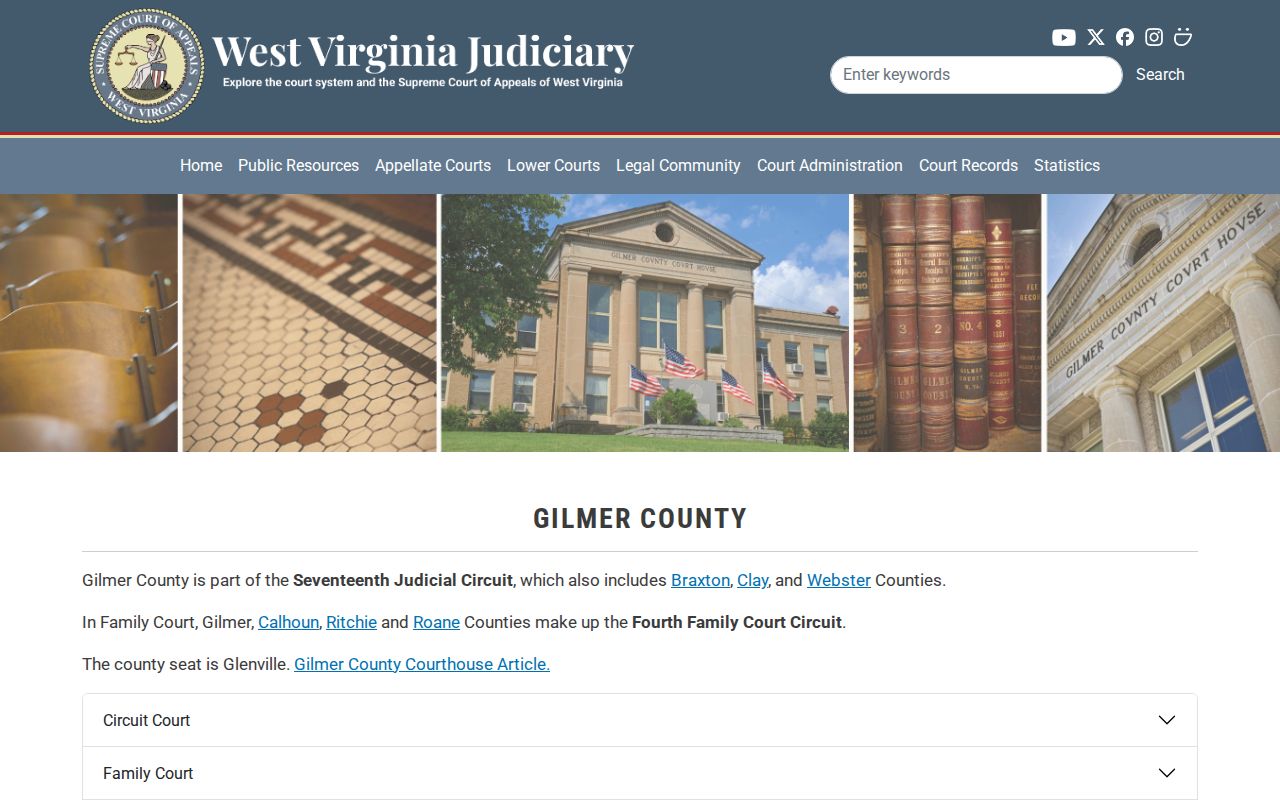
The directory entry helps separate the two addresses and routes a request to the court that owns the docket.
Finding Court Dates and Settings
A setting can be many things. It may be an arraignment, pretrial conference, motion hearing, status conference, trial, sentencing, or another event. Read the setting type as well as its date. Gilmer County Circuit Court terms begin on the first Monday of March, July, and November under Trial Court Rule 2.17. But a term date is not a promise that a particular case will be heard that day. Rely on the latest signed notice or order, then confirm a change with the clerk. A docket may show a reset or continuance. Yet an old screen or a broad status label should not override a later court order. Weather or closure can also affect a setting. The Judiciary provides a court closure search, though that is not a case calendar. The Gilmer County court calendar process explains the comparison. It shows how to weigh a notice, docket entry, and clerk confirmation. If a date has passed, contact the court promptly. Do not treat silence in the portal as a cancellation.
Gilmer County Court Docket Terms
Short docket words can change how an event reads. These terms describe procedure and record status, and they do not replace the signed document behind an entry.
- Setting
- A scheduled court event, not necessarily a trial.
- Continuance
- An order moving an event to another date.
- Disposition
- The recorded outcome of a claim, charge, or case.
- Register of actions
- Another term for the dated docket-event list.
- Certified copy
- A reproduction authenticated by the clerk, unlike a routine portal download.
A code or label on a docket entry can matter when a deadline is at stake. When it does, ask the clerk to pull the order or notice behind the entry. Clerks will explain where a record sits and how the process works, but they cannot give legal advice.
Public Access to Dockets
West Virginia law backs public inspection and clerk copies of court records. The limits come from rules, statutes, and sealing orders. Public access is not the same as an open file. Juvenile records stay confidential unless disclosure is authorized. A family case index and its orders may be public. Even so, the pleadings, exhibits, recordings, and sensitive material can remain off limits. Domestic-violence and mental-hygiene files carry their own restrictions.
Key access rules:
West Virginia Code §51-4-2 supports inspection and clerk copies of open court records.
West Virginia FOIA §29B-1-3 sets a focused written-request and five-day response framework.
West Virginia Code §49-5-103 restricts juvenile records except where disclosure is authorized.
A docket search that comes up empty does not prove a case is absent. The miss may come from a security level, a sealed filing, an excluded case type, a date outside portal coverage, or paper held only at the counter. Treat a failed search as one dead end, not a final answer.
Gilmer County Court Docket Fallback Chain
When an online docket search fails, work a set order. Confirm the court first, and copy the case number from a notice. Then run the proper public system using the number and the name. Still nothing? Call the Circuit Clerk or the Magistrate Clerk next. If you need the document itself, go to the counter. Or ask about a mail or fax request. For an open public record that sits outside the normal docket workflow, a focused written request may fit. The West Virginia Freedom of Information Act can be the vehicle. Give the clerk the county, the court, the case number, and the case style. Add the document or event date, the copy type you want, your return address, and contact information. Ask about fees and accepted payment before anything goes in the mail. For an old file, ask whether it lives in paper, microfilm, or electronic storage. If the file is restricted, ask which rule, statute, or court order controls access. Every documented channel for Gilmer County fits somewhere in this chain. That means online search, phone, counter service, mail, fax, registered e-filing where authorized, certification through the clerk, and a specific records request when one applies.
The Clerk and Docket Records
The Circuit Clerk keeps the official Gilmer County circuit and family dockets. The office holds pleadings, documents, funds, jury functions, process, and court statistics. It also issues certified circuit docket sheets, orders, judgments, and copies of filed documents. The Magistrate Clerk runs the separate magistrate docket. Case information, filings, judgments, settings, and cost or payment data sit on that side of the courthouse split.
Gilmer County Circuit Clerk
Pam Starsick
10 Howard Street
Glenville, WV 26351
304-462-7241
Gilmer County Magistrate Clerk
Bridget Norman
201 North Court Street
Glenville, WV 26351
304-462-7812
County Clerk Jean Butcher works in the same courthouse, but that office keeps county commission, land, probate, vital, and election records. It is not a substitute for the Circuit Clerk when you need a court docket.
Gilmer County Court Docket Access Timeline
Gilmer County's digital record layers were built for different users. Public WVPASS circuit coverage generally starts July 1, 1999. CourtPLUS and Circuit-Family E-File went live in the county on October 1, 2018. CourtPLUS is the registered filing and court-management layer. WVPASS is the public circuit-access layer. MCR later added statewide public magistrate result searches. The clerk kept the document-copy role. The statewide e-filing status table records the Gilmer County live date.
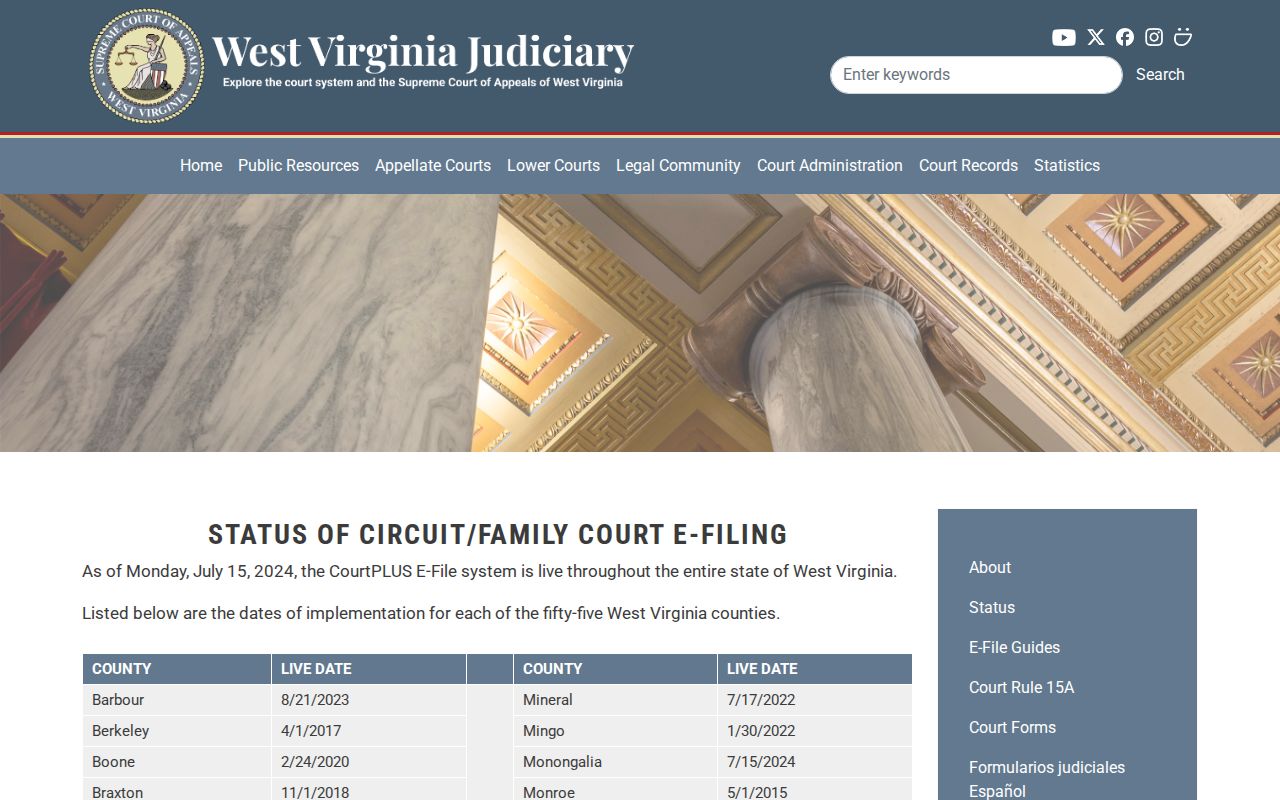
That live date marks a filing milestone, not a promise that every case page turned public or paperless. Self-represented parties can still paper-file, and sealed material follows restricted filing rules.
Gilmer County Court Docket Access Costs
Reading WVPASS case detail costs nothing, and MCR searches are free too. Document images on WVPASS run $0.25 per page plus a nominal card processing fee. The portal shows the page count before you buy. It keeps purchase history for thirty days, and gives no refund on a completed purchase. Its download is not certified.
| Need | Published cost | Route |
|---|---|---|
| Read circuit case detail | Free | WVPASS |
| View public circuit image | $0.25 per page plus processing | WVPASS |
| Read magistrate result | Free | MCR |
| Magistrate document copy | Nominal; exact price not published | Magistrate Clerk |
| Circuit clerk copy in listed category | $1 per page under §59-1-11 | Circuit Clerk |
| Certified copy surcharge | Not published | Confirm with clerk |
Never guess at a certification charge or a mail payment method. Name the item and copy type, then get the current total from the clerk.
Court Dockets by City in Gilmer County
Gilmer County has two incorporated places in the population source behind the city profiles. They are Glenville and Sand Fork. Neither town runs an official public municipal docket or payment portal. A local ordinance citation should be routed by the court name printed on the ticket. State-law criminal, traffic, civil, and family matters stay on the proper county or state-court path. Town lines make no difference there.
Glenville Court Docket
2020 population: 1,129
County seat and home of both Gilmer County court counters; municipal contact is 304-462-7411.
Sand Fork Court Docket
2020 population: 180
Municipal contact is 304-804-2177; use the ticket's named venue for a local ordinance matter.
The West Virginia municipal contacts table confirms contacts for both towns. Living inside a city line does not pick your docket system; court level and case type do.
Gilmer County Court Docket Courthouse History
The current courthouse is Gilmer County's third. County history puts its completion in 1923. The two-story brick-and-stone building shows limestone detail. It also has a sandstone foundation, Doric columns, and a gabled portico. A two-story brick-and-glass annex followed in 1974. Those features help you spot the building at 10 Howard Street. They say nothing about current entry rules, parking, security steps, or counter hours.
Both the Circuit Clerk and the County Clerk work inside. Office names therefore matter more than the word "courthouse." Route a circuit or family docket request to the Circuit Clerk. Land, probate, vital, election, and county commission questions go to the County Clerk. Magistrate docket work happens at the separate North Court Street building. The official Gilmer County homepage depicts the county courthouse and supplies county navigation.
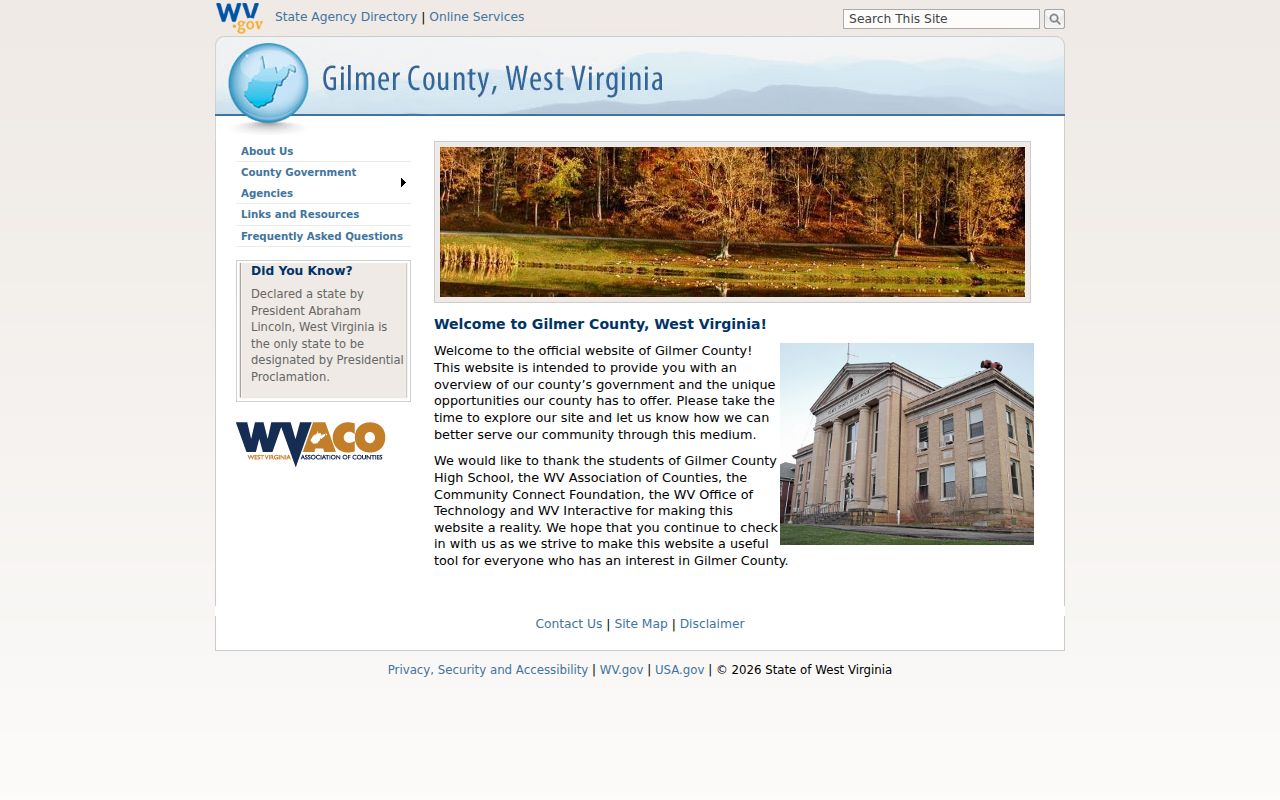
The courthouse image adds local color, while the office split keeps a visitor from waiting at the wrong record counter. Knowing which clerk holds which docket saves the trip.
Map and Directions to the Gilmer County Courthouse
Circuit Court and family court files are kept at the Gilmer County Courthouse, 10 Howard Street, in Glenville. The building also houses the County Clerk's separate land-recording and probate office, so visitors should name the Circuit Clerk when they arrive. Magistrate Court records are kept in a different building at 201 North Court Street, a few blocks away, for misdemeanor, traffic, small-claims, and preliminary matters.
No public-counter hours, parking plan, or security-screening policy for the courthouse was found in the research, so calling the Circuit Clerk's office before a visit is the safest way to confirm hours and what to bring.