
How to Get Gilmer County Court Records
First, figure out which court handled the matter. The notice, signed order, or docket in hand will name it. The West Virginia Judiciary Gilmer County directory lists both clerk offices. Pam Starsick is the Circuit Clerk. She keeps circuit and family records at 10 Howard Street in Glenville. Bridget Norman, the Magistrate Clerk, holds magistrate files at 201 North Court Street. The County Clerk is a different office entirely. It handles land, probate, vital, election, and county commission records rather than the circuit docket.
For circuit material, eligible cases sit in WVPASS. Magistrate results show up in Magistrate Case Search, or MCR. That tool offers no document images. You can also call, visit, mail, or fax the right Gilmer County clerk. The clerks publish no mail-order packet, payment list, or turnaround time. Confirm those details before sending money.
- Decide whether the item is a docket sheet, filed document, or certified copy.
- Identify the Gilmer County court, case number, style, document title, and event date.
- Search WVPASS for circuit material or MCR for magistrate information.
- For a clerk request, state the copy type, return address, contact details, and delivery choice.
- Ask about the current fee, payment method, archive location, and any access qualification.
Three Gilmer County Record Levels
In Gilmer County, one word covers three different products. The docket is the timeline and index. Its formal name is the register of actions. It tells you a pleading was filed or a hearing happened, but rarely shows the text behind the entry. A filed document is the actual complaint, motion, exhibit, order, judgment, transcript, or attachment. A certified copy is a clerk-authenticated reproduction. A downloaded page does not qualify, WVPASS states plainly.
| Product | What it answers | Gilmer County route |
|---|---|---|
| Docket or register | What happened, and when | WVPASS, MCR, or clerk |
| Filed document | What a filing or order says | WVPASS or the proper clerk |
| Certified copy | An authenticated court copy | Circuit Clerk or Magistrate Clerk |
A docket line reading simply "motion granted" can leave the real terms unstated. When the question is what the judge actually directed, request the signed order. When final relief matters, request the judgment itself rather than the disposition line alone.
Types of Gilmer County Court Records
A Gilmer County case file can hold many items. Those include an index, docket sheet, complaint or petition, answer, motion, signed order, judgment, transcript, recording, or exhibit. Where each item lives depends on the court. The Circuit Clerk keeps circuit civil and criminal records. The Magistrate Clerk holds traffic, misdemeanor, preliminary, and small-claims files. Family Court indices and orders may be public. Pleadings, exhibits, recordings, and sensitive support material are generally restricted.
- Docket sheets and event histories
- Pleadings, motions, and responses
- Signed orders and final judgments
- Transcripts or authorized court recordings
- Exhibits and attachments, when public
Transcripts follow a different path. The clerk's docket can identify the hearing, but a transcript is not an ordinary clerk copy; it goes through the court reporter or transcriber. Family Court rules do allow a written request for authorized recordings, supplied within ten days at cost.
Gilmer County WVPASS Document Access
WVPASS is the public route to eligible Gilmer County Circuit Court records from July 1, 1999 forward. Browsing case details costs nothing. Once registered or signed in, you can search by party or case number, open the case, and review Docket Entries or Documents. Public images run $0.25 per page plus a small card-processing charge. The portal shows the page count before purchase, keeps purchase history for thirty days, and gives no refunds.
The official WVPASS FAQ spells out those limits. Keep perspective, though: if something is missing from the portal, that does not mean the Gilmer County record never existed. It may be too old, unscanned, restricted, sealed, or held only at the clerk's office. The Circuit Clerk can tell you which.
Note the difference between the two systems. WVPASS serves public access, while CourtPLUS/Circuit-Family E-File is mainly the registered filing and case-management platform. Gilmer County went live on it October 1, 2018. Filing rights and public viewing are separate permissions.
What a Gilmer County Court Record Contains
The docket index opens the door. A Gilmer County case file ties that index to the public documents stored behind its entries. The case number is the best key when requesting anything from a clerk. The case style tells you who the parties are. Filing dates separate documents with similar titles. The signed orders and judgments state what the court actually ruled.
| Case number | The court file identifier and best search key. |
|---|---|
| Case style | The caption and party roles as filed. |
| Docket sheet | The chronological list of filings, settings, and events. |
| Pleadings | Claims, defenses, motions, and responses, not findings. |
| Orders and judgments | Signed rulings, conditions, and final relief. |
| Exhibits | Attachments that may be public, redacted, restricted, or sealed. |
Write down the case number, filing date, and event date before calling a Gilmer County clerk. That record-keeping pays off. It helps you tell the difference between a document that is not online, one that is not public, and one your search simply missed.
Gilmer County MCR Copy Fallback
MCR gives free result information for Gilmer County Magistrate Court. The search runs behind a CAPTCHA. It accepts a first name, last name, or case number. A result may include a name and birth date. Filing date, charge, disposition, and document list can appear too. Common-name searches cap out at thirty results. An exact case number works best.
Per the Judiciary's MCR instructions, the documents themselves are not online. For a copy, call the Magistrate Clerk at 304-462-7812. You can also visit 201 North Court Street, Glenville, WV 26351. Ask about the current charge. The official pages mention a nominal fee without publishing a per-page amount.
The MCR entry screen is the search route for Gilmer County magistrate cases.
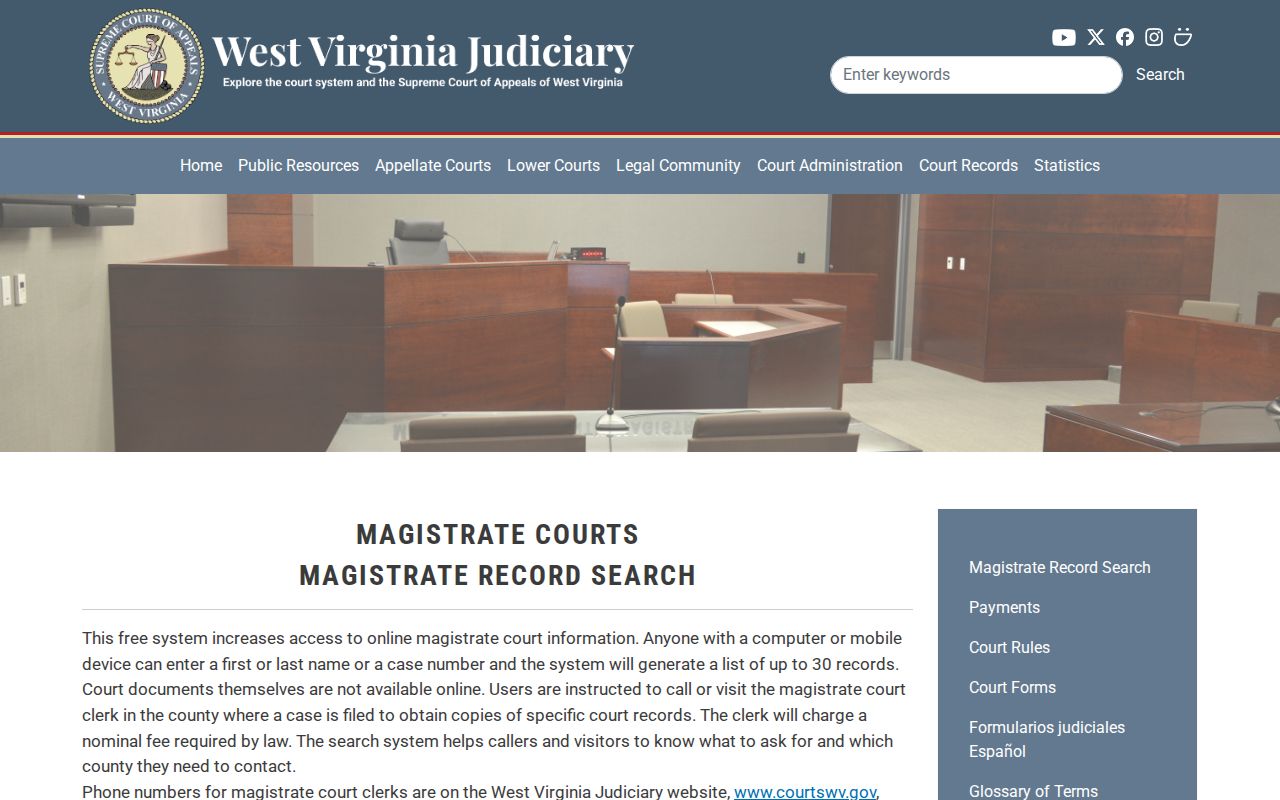
That is the whole arrangement in one view: MCR locates Gilmer County magistrate case information, and the Magistrate Clerk supplies the file copy.
Certified Copies and Gilmer County Fees
What is the difference between a plain copy and a certified one? A plain copy just reproduces a public page from the court record. A certified copy carries the clerk's authentication. It works as official proof. If you need that kind of proof, ask the Gilmer County clerk to certify the document rather than paying for a WVPASS download. State law sets the fee at $1 per page. That covers a circuit-clerk transcript, copy, or paper prepared for use outside the office. No separate Gilmer County certification surcharge is published. No magistrate per-page price or mail payment method appears either.
| Item | Known amount |
|---|---|
| WVPASS case detail | Free |
| WVPASS public document | $0.25 per page plus card processing |
| Circuit-clerk copy in listed category | $1 per page under §59-1-11 |
| Certified copy surcharge | Not published; confirm with clerk |
| Magistrate document copy | Nominal fee; exact amount not published |
| FOIA reproduction | Actual reproduction cost |
Gilmer County Circuit Clerk
Pam Starsick
10 Howard Street
Glenville, WV 26351
304-462-7241
Fax: 304-462-7038
Older Gilmer County Court Files
Hunting an older Gilmer County court file? Give the clerk what you can. That means an approximate year, the case type, party names or the case style, and any old index or case number. Ask how the record is stored, whether on paper, microfilm, or electronically. West Virginia Code §51-4-3 allows permanent preservation through microfilm and electronic methods. The county publishes no retrieval schedule, so a specific request saves real time. Name the exact item you want, whether a docket sheet, order, judgment, pleading, exhibit, or transcript. If the office will not release it, ask why. A sealing order, a confidentiality rule, a missing scan, and an archive problem are four different outcomes. Each has a different fix.
Public Access to Gilmer County Court Records
Access to Gilmer County court records is broad. But it has limits. A clerk can hand you an open record for inspection or copying. What a clerk cannot do is override a sealing order from a court. Juvenile records stay closed unless disclosure is authorized. Domestic-violence and mental-hygiene files follow their own confidentiality rules. Family Court indices and orders are treated differently from pleadings, exhibits, recordings, and sensitive attachments.
Key access rules:
West Virginia Code §51-4-2 makes court records open to inspection and authorizes clerk copies, subject to lawful restrictions.
West Virginia Code §49-5-103 restricts juvenile records except for authorized statutory access.
West Virginia FOIA §29B-1-3 provides written-request, electronic-copy, five-day response, and actual-copy-cost rules.
A FOIA request works best when it lands with the right custodian and names the office, court, case number, date range, and file type. The five-day clock skips weekends and legal holidays. At the end, the custodian may produce the record, announce a time for inspection, or deny the request in writing. The official FOIA text spells out the inspection and response provisions.
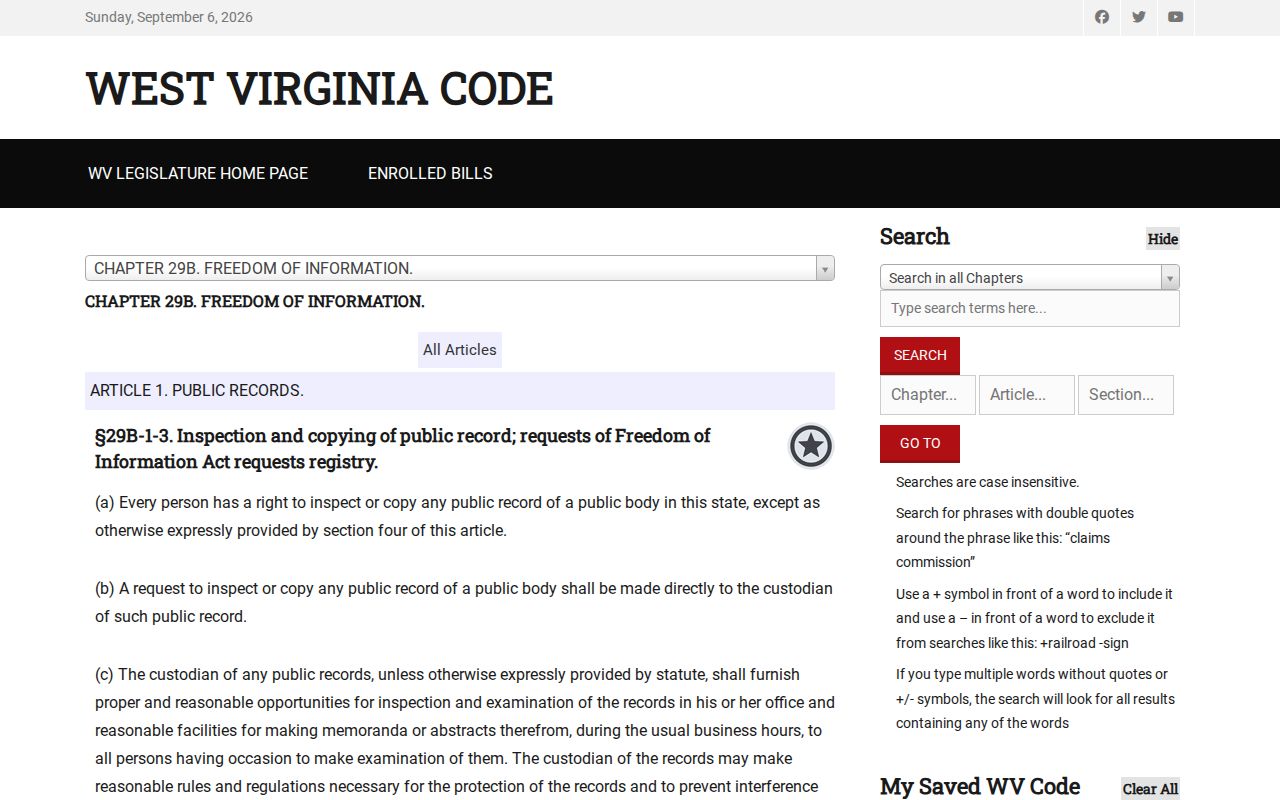
In short: the written-request channel and the custodian's duty to respond sit side by side in the statute, but none of it loosens the court-specific access limits.
Which Gilmer County Clerk Holds It
Which Gilmer County clerk you contact depends on the case. Circuit criminal, civil, juvenile, abuse and neglect, appeal, and eligible family requests go to the Circuit Clerk. Misdemeanor, traffic, felony preliminary, small-claims, and other magistrate matters go to the Magistrate Clerk. Probate, estate, land, vital, election, and county commission records sit with the County Clerk.
No case number yet? Try the right portal first, then call with a party name and an approximate year. A name-only phone request gets weaker results. And no clerk has to give you a legal summary. The Gilmer County case search options can turn up a number. Then ask for copies.
If a request is denied or stalled, request the reason in writing. A tight ask for one named public document beats a broad one. A broad ask has no court, date, or file type attached.